Landmarks near the old town
Rather than splitting them across more than a dozen near-identical "hotel near X" pages, one per nearby landmark, here's a single guide bringing together the genuine historical facts behind each one.
San Lorenzo Cathedral
The Cathedral of San Lorenzo stands directly opposite the palazzo, on the square that gives it its name. There's little independent history of the cathedral itself to add here beyond its central, defining position in the old town. Local legend does attach to the palazzo across the square, though: the ghost of Scipione Cicala, described as "a dreadful Genoese pirate," is said to still haunt its corridors facing the cathedral.
Palazzo Ducale & Piazza Banchi
Palazzo Ducale, Genoa's civic palace on Piazza Matteotti, took its "Ducale" name in 1339 when it became the seat of the city's first Doge, Simon Boccanegra, and was gradually enlarged over the following centuries. Accounts vary on when construction actually began, with some sources giving the end of the 11th century and others the end of the 13th. Its tower and former prisons held a number of notable prisoners, including the painter Sinibaldo Scorza and the painter Pieter Mulier ("Il Tempesta"). The building today hosts changing art exhibitions and galleries.
Piazza Banchi, a short walk away, has been described as Genoa's economic heart for over ten centuries — historically a site for trading grain and negotiating shipping. Palazzo Serra, a 16th-century palazzo of the noble Serra family standing beside San Pietro church and the Loggia dei Mercanti (built as part of a 16th-century urban redevelopment that also produced Italy's first grain exchange), was restored over a four-year project; its ground floor retains original Finale Ligure stonework and exterior frescoes.
Via Garibaldi
Via Garibaldi — historically "Strada Nuova" — is a UNESCO World Heritage street of 16th-century merchant-banker palazzi. Especially notable is Palazzo Lomellino, at Via Garibaldi 7, built from 1563 in honour of Nicolosio Lomellino, constructed by Gaetano Cantoni to a design by Giovanni Battista Castello ("il Bergamasco"), with stuccowork by Marcello Sparzo. It later passed to the Centurione family, then in 1711 to the Pallavicini family (who carried out major renovations), and was bought in 1865 by Genoa's mayor, Andrea Podestà. A documented 1625 dispute between the painter Bernardo Strozzi and the Centurione family confirms Strozzi frescoed three rooms on the first noble floor — later hidden under plaster and a false ceiling, and rediscovered in 2002, revealing an intact "Allegoria della Fede" fresco and fragments of two further works.
Teatro Carlo Felice
Genoa's main opera house sits a short walk from the old town, on Piazza De Ferrari. There's no independent history of the theatre itself to add here beyond confirming its location as a well-known Genoa landmark.
Porto Antico & the harbour
Genoa's old port was substantially redeveloped in 1992 for the "Colombiadi," marking the 500th anniversary of Columbus's voyage. The harbour is one of Italy's principal seaports, and Porto Antico's attractions include the Aquarium (called one of the largest in Europe), the Biosfera, the Bigo panoramic lift, a children's museum, the Galata Museo del Mare, and Palazzo San Giorgio (the historic seat of the Genoa Port Authority) — plus a walk to the Lanterna, the lighthouse that is Genoa's civic symbol.
Ferry docks
The old town's ferry terminal serves routes to Corsica, Sardinia and other Mediterranean destinations. Near the Ducale apartment (named for its view of Palazzo Ducale), Salita Pollaiuoli is said to take its name from the poultry and game-meat shops ("pollaiuoli") once located there in the 17th century, following the passage of Charles VIII's and Louis XII's armies through the city.
Other historic palazzi
We have no genuine information to report on two other named palazzi in the old town, "Palazzo Gentile" and "Palazzo Meridiana," and haven't invented anything to fill the gap.
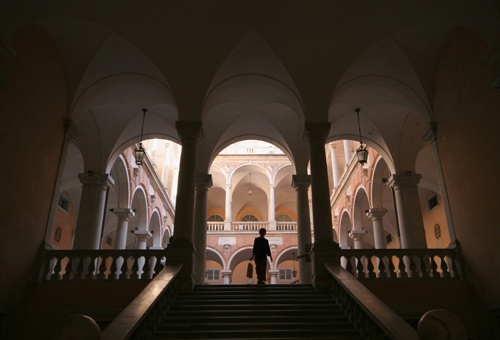
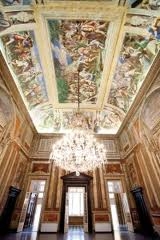
A different building nearby is known as "Palazzo di Lazzaro Grimaldi," home to two studio apartments, each with a living area, a fully-equipped kitchen and a mezzanine double bedroom, near Palazzo Spinola — today a well-known public gallery on Via Garibaldi's museum circuit. Palazzo Imperiale's own history also namechecks Palazzo Tursi (on Via Garibaldi) as one of the era's other great mansions. Photography of both buildings' interiors is below.
Boccadasse
East along the seafront from the old town, past the end of Corso Italia, Boccadasse is a small former fishing village that was only formally absorbed into the city of Genoa in 1873. Its cluster of pastel-coloured houses around a pebble beach is said locally to date back to fishermen settling the bay around the year 1000, though that's a local legend rather than a documented fact. The name itself is usually explained as coming from the Genoese dialect "bócca d'âze" ("donkey's mouth"), describing the shape of the bay, though older theories point instead to a stream once called "Asse" or to a medieval landowner. Some fishing families reportedly still work from the beach today, alongside the gelaterie and restaurants that have made it a popular photo stop. We couldn't confirm an exact walking distance or time from the old town, so treat any "just a stroll away" claim with the same caution as the rest of this page.
Monumental Cemetery of Staglieno
North of the old town, in the Staglieno district, Genoa's Cimitero Monumentale di Staglieno opened in 1851, following a design approved in 1835, prompted by Napoleon's 1804 Edict of Saint-Cloud banning burials within city churches and towns. Covering more than a square kilometre, it's counted among the largest cemeteries in Europe and became, from the 1850s onward, a showcase for Realist funerary sculpture commissioned by Genoa's affluent 19th-century bourgeoisie — work by sculptors including Giulio Monteverde and Leonardo Bistolfi lines its terraces and colonnades, alongside a domed Pantheon modelled on Rome's. Notable burials include the Italian patriot Giuseppe Mazzini and the singer-songwriter Fabrizio De André. It's a genuine sight in its own right rather than a typical doorstep attraction, so it's best treated as a dedicated excursion rather than a quick walk from the old town.